
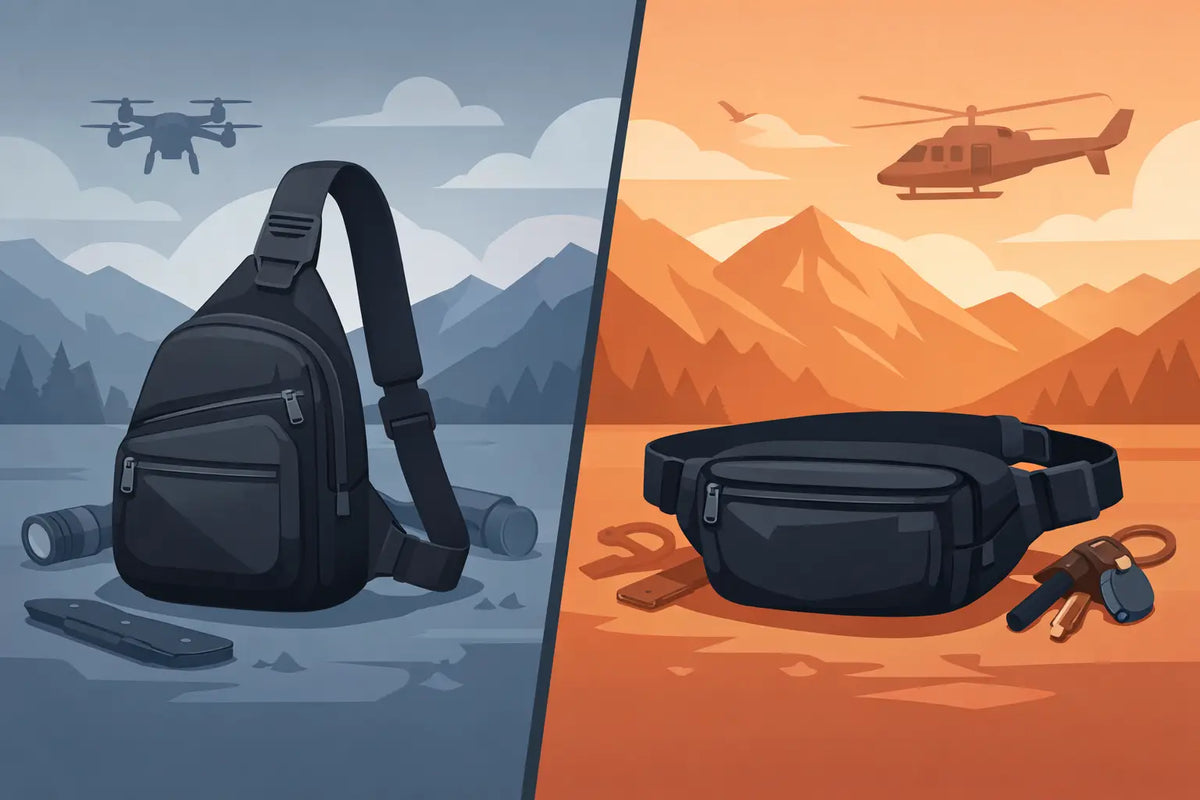
A radio call comes in, your phone starts ringing, or you need a tourniquet without digging through a full-size pack. That is where the sling bag versus waistpack decision stops being about style and starts being about access. Both carry systems keep essential gear close, free up your hands, and handle daily movement better than stuffing every pocket you own. The right one depends on what you carry, how fast you need it, and how hard you move.
For everyday carry, range use, travel, job sites, and trail work, neither option wins across the board. A sling gives you more organized capacity and a higher carry position. A waistpack stays planted, moves naturally with your body, and provides fast front access. Know the mission, then choose the platform that will not slow you down.
Sling Bag Versus Waistpack: The Core Difference
A sling bag rides diagonally across the back or chest on a single shoulder strap. Most are designed to rotate forward without fully removing the bag, giving you access to compartments while standing, walking, or seated. It is a compact load carrier that bridges the gap between pocket EDC and a backpack.
A waistpack, often called a hip pack or belt bag, wraps around the waist or can be worn crossbody. Its weight sits low and close to your center of gravity. That makes it especially effective when you need freedom of movement, whether you are climbing into a vehicle, working around equipment, hiking uneven ground, or spending hours on your feet.
The practical difference is simple: slings prioritize capacity and organization; waistpacks prioritize stability and immediate access. Your daily load determines which advantage matters more.
When a Sling Bag Earns Its Place
A sling is the better call when your essentials extend beyond wallet, keys, and medical gear. It gives you room for a compact water bottle, charger, notebook, sunglasses, gloves, spare batteries, a small tool kit, or range essentials without stepping up to a full rucksack.
Better organization for a larger EDC load
Slings usually offer multiple zippered compartments, internal admin sleeves, and exterior attachment points. That structure matters when your kit has to stay organized under pressure. Instead of loose gear piling up in one pouch, you can separate medical items from electronics, keep a flashlight where your hand expects it, and isolate dirty or wet gear from the rest of your load.
For commuters and travelers, this layout pays off quickly. A compact tablet, documents, cables, and power bank fit more naturally in a sling than in most waistpacks. For range users, a sling can keep eye protection, ear pro, a small cleaning kit, magazines where lawful and appropriate, and personal items in one controlled package.
A stronger fit for vertical carry
The sling’s back or chest position makes it useful when your waist is already occupied. If you wear a duty belt, tool belt, climbing harness, or concealed-carry setup, adding a waistpack can create crowding and interference. A sling keeps its footprint higher and leaves your beltline clearer.
That placement also helps in crowded spaces. Worn on the back, a sling stays out of the way while you move through an airport, job site, or event. When you need access, rotate it to the front and keep visual control of the compartment openings.
Modularity for changing loadouts
A capable tactical sling can expand with MOLLE/PALS webbing, allowing you to add a small utility pouch, medical pouch, or other mission-specific attachment. This is useful when your daily needs change from workday to weekend without requiring a separate bag for every role.
Look for reinforced attachment points and straps that hold their adjustment. Loose webbing and thin buckles turn a useful sling into a shoulder-swinging nuisance. Gear failure is not an option when the bag carries the tools you need to do your job or handle an emergency.
When a Waistpack Is the Better Tool
A waistpack shines when movement and stability outrank capacity. Its lower profile makes it less likely to shift during a fast walk, a trail scramble, repetitive bending, or vehicle work. You do not have to manage a strap across your chest, and you avoid the one-sided shoulder load that can wear on you over a long day.
Rock-solid stability while moving
Because a waistpack sits around the hips, it stays closer to your natural center of gravity than a sling. That is a real advantage for hiking, cycling, running, training, and physical work. A properly tightened waist belt reduces bounce and keeps the bag from swinging forward every time you bend over.
For first-aid gear, this stability is especially valuable. A compact waistpack can keep trauma supplies, gloves, a light, and communication essentials directly in front of you. You can reach the kit quickly without taking off a backpack or spinning a loaded sling around your body.
Faster access when seconds matter
A waistpack worn in front gives you immediate access with both hands. There is no rotation step, no shoulder strap to manage, and less chance of the bag landing in an awkward position when you are seated. That can make it the better option for travel documents, work credentials, small tools, emergency gear, or a grab-and-go medical loadout.
It also works well as a supplement to a larger pack. Carry the bulk of your equipment in a ruck, then keep navigation, snacks, headlamp, phone, and critical medical items on your waist. When you set down the main pack, your essentials stay with you.
Lower capacity can be a benefit
A waistpack’s limitation is also a discipline tool. It forces you to carry the gear you actually use rather than loading up every available pocket. If your core EDC is a phone, wallet, keys, multitool, flashlight, compact medical kit, and a few small personal items, a waistpack keeps the system lean.
The trade-off is obvious. Once you add a bottle, electronics, substantial tools, or cold-weather layers, most waistpacks fill fast. Overloading one creates sag, bounce, and uncomfortable pressure around the waist. At that point, a sling or small backpack is the more capable platform.
Comfort, Concealment, and Vehicle Use
Comfort depends less on the bag category than on fit and load discipline. A sling becomes uncomfortable when overloaded or worn on one shoulder all day. If you carry it for extended periods, switch sides when possible and keep dense items close to the back panel. A wide, padded strap helps spread the load, but it cannot overcome poor packing.
A waistpack can cause hot spots if the belt is too tight or if hard tools press into your abdomen. It may also interfere with a seat belt, a vehicle console, or other belt-mounted equipment. For long drives, many users move the pack slightly to the side or unclip it and place it within reach.
Concealment is another situational call. A compact waistpack can look like standard outdoor or travel gear, while a large sling with visible webbing signals a more tactical purpose. There is nothing wrong with a mission-ready appearance, but consider your environment. For urban commuting or air travel, subdued colors and a clean exterior often draw less attention than a heavily loaded, accessory-covered bag.
How to Choose Your Carry System
Start with the gear that must stay on your body, not the gear you might carry someday. Lay out your daily essentials, then account for the environment. Do you need to move fast, sit in a vehicle, carry a tablet, work around a belt, or maintain access to medical equipment? Those answers point toward the right system.
Choose a sling if your load is medium-sized, organization matters, and you want room to scale up. It is the more versatile choice for work commutes, range days, travel, and all-purpose EDC. A quality sling with durable zippers and MOLLE/PALS compatibility can cover a lot of ground without becoming a full pack.
Choose a waistpack if you need a compact, stable kit that stays accessible through constant movement. It is hard to beat for hiking, training, event work, medical essentials, and minimalist EDC. Keep it tight, keep it organized, and resist the urge to overload it.
Shadow Gear USA gear is built for the users who need that flexibility: work-ready storage on Monday, trail or range capability on Saturday, and dependable EDC every day between.
The best carry setup is the one you will wear consistently and can operate without thinking. Pack it with purpose, test it while moving, and let the demands of your next shift, trip, or training day make the final call.
Shadow Gear Picks
- Scout 5L Tactical Sling Bag: an ambidextrous sling with a MOLLE front and a retention sleeve that locks a flashlight or multi-tool in place.
- Shuttle 4L Convertible Sling Pack: five pockets, left- or right-shoulder carry and a quick-release top buckle.
- Dash 4L Tactical Waist Pack: four zippered compartments, stitched battery slots and MOLLE webbing, worn close at the waist.
Every Shadow Gear bag is built from water-resistant 600D polyester and backed by the Shadow Gear Lifetime Warranty. 2% of net product sales go to Folds of Honor.
0 comments